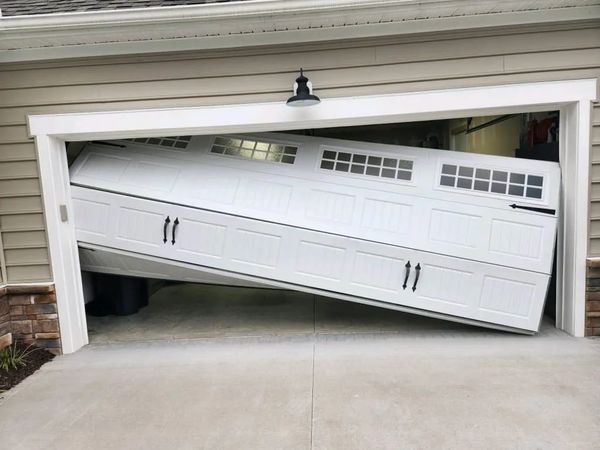
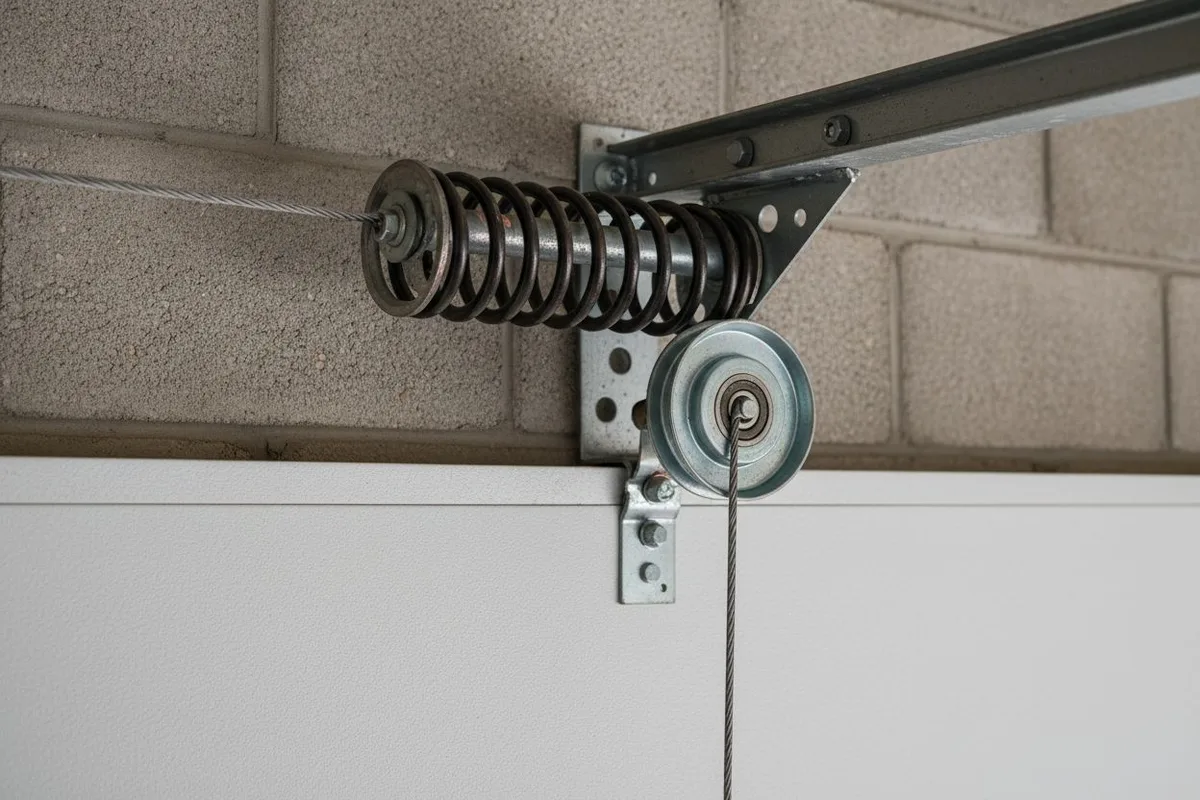
Quick answer: A broken garage door spring should be replaced by a professional in nearly every case. Torsion springs hold 300-400 pounds of stored energy and account for an estimated 30,000 ER visits per year from DIY attempts. A professional spring replacement takes 45-60 minutes, costs $250-$450 for a single spring ($350-$450 for both), and includes balance testing and safety-reverse calibration. Read on for how to identify which type of spring failed and what to expect.
How to tell if your spring is actually broken
Four telltale signs of a broken spring:
- You heard a loud bang. A spring snapping under tension sounds like a gunshot - usually heard from inside the house even with the garage door closed.
- The door won\'t lift, or only opens 4-6 inches. The opener tries, the motor strains, and the door barely moves. This is the most common symptom.
- You can see a gap in the spring coil. Look at the spring above the door (or along the tracks). Normally tight coils. After breaking, there\'s a visible 1-3 inch gap.
- The door is heavy if you try to lift it manually. A door with intact springs lifts with one finger; a door with a broken spring weighs 150-300 pounds.
Identifying your spring type - torsion vs extension
Two systems exist; the repair approach differs:
Torsion springs (most common, 1990s and newer doors)
Mount on a horizontal bar above the door opening. Twist as the door lowers, providing lift when the door rises. One spring on smaller doors, two on standard 16-foot wide doors. Most common in modern South Florida homes. Heavier-duty, last longer (10,000-cycle standard), but require professional tools to safely replace.
Extension springs (older doors, 1980s and before)
Run horizontally along each track of the garage door, attached to the back of the door and to a bracket near the ceiling. Stretch when the door closes, contract to provide lift. Always come in pairs. Safer to work on than torsion (lower stored energy per spring), but still dangerous without proper experience and safety cables. Should have a safety cable running through the center of each spring to prevent the spring from becoming a projectile when it fails.
Why DIY spring repair is almost never the right call
This is the part most home-improvement YouTube videos skip. Here\'s what professionals know:
- Torsion springs hold 300-400 pounds of stored energy. A spring failure during installation can throw a winding bar across the garage at lethal velocity.
- The wire gauge has to be exact. Wire diameters range from .192" to .284", in steps of .005". Use the wrong gauge and the door is unbalanced - wears out everything faster.
- Cones must be replaced with springs. The end cones that connect the spring to the shaft are sized to the spring and can\'t be reused.
- Balance is critical. An unbalanced door wears out the opener motor in 1-3 years instead of 15.
- Your homeowners insurance probably won\'t cover DIY injury. Most policies exclude injury from DIY contractor-grade work.
The savings vs professional repair: $80-$150 in labor. The downside: an ER visit averages $1,200-$2,500 if you\'re uninsured, plus the cost of a professional finishing the job correctly. Even mechanically-confident homeowners should use a pro for spring replacement.
What a professional spring repair looks like
For context, here\'s what we do on a typical residential torsion-spring repair:
- Arrival + assessment (10-15 min) - Photo of existing spring, measure wire gauge, inside diameter, length. Inspect cones, cables, bearings.
- Quote in writing (5 min) - Spring type, gauge, count, hardware needed, total. Hold against final invoice.
- Lockout/tagout - Disconnect opener power. Secure door in closed position with C-clamps to track.
- Cone unwind (5-10 min per spring) - Two winding bars, alternating bar method to release stored tension safely. This is the dangerous step.
- Spring removal + replacement (10-15 min) - Loose set screws on cones, slide off old spring, install new spring matching exact specs.
- Cone winding (10-15 min per spring) - Wind the spring to factory-spec turns (usually 7.5 turns for a 7-ft door). This is the second dangerous step.
- Balance test (5-10 min) - Door should hold position when lifted halfway with opener disconnected. If it falls or rises, springs need adjustment.
- Reconnect opener + safety-reverse test (5 min) - Test sensor alignment, run safety-reverse procedure with a 2x4 on the floor.
- Walkthrough + warranty - Show you the work, explain warranty (1 year labor + manufacturer warranty on spring).
Total time on-site: 45-60 minutes for a single spring, 75-90 minutes for both.
Why both springs should be replaced together (in 95% of cases)
If your door has dual springs and one breaks, the other almost always fails within 6 months - they have the same cycle history. Replacing them together costs roughly 30% less than two separate service calls, and it eliminates the gamble of when the matched spring will fail. Single-spring replacement only makes sense if the door has just one spring (smaller residential doors, single-bay garages with light doors).
Pricing in South Florida (2026 numbers)
- Single torsion spring replacement: $250-$350
- Dual torsion springs (both): $350-$450
- Heavy-duty / oversize doors (carriage, double): $450-$650
- Extension springs (pair): $200-$325
- Bearings + cone replacement (recommended at 7+ years): +$60-$120
- Cable replacement (if cables are frayed): +$80-$160
South Florida pricing runs slightly above the national average because of the higher salt-air corrosion rate and the standard requirement for galvanized or stainless hardware on coastal-block jobs.
How long springs last in South Florida
Standard residential springs are rated for 10,000 cycles. One cycle = one open + one close. The national average homeowner hits 10,000 cycles around year 14. In South Florida, where most households use the garage as the main entry door and cycle it 6-8 times per day, the typical 10,000-cycle mark is reached in 4-7 years. Add humidity-driven steel fatigue and salt-air corrosion on coastal blocks, and Broward / Miami-Dade / Palm Beach springs commonly need replacement at year 5-7, not 14.
Preventing the next spring break
- Annual tune-up - $79-$129 includes lubrication, tension check, balance test
- Choose extended-cycle springs on the replacement - 20,000-cycle springs cost 20% more but last roughly twice as long
- Don\'t cycle the door more than needed - Keep it closed unless actively in use
- Replace cables and bearings proactively at 7 years - Cheap insurance against the next failure
Frequently asked questions
How much does a broken garage door spring repair cost?
Single spring: $250-$350. Both springs together: $350-$450. Heavy-duty or oversize doors run higher ($450-$650). The price includes the spring, labor, balance test, safety-reverse calibration, and 1-year warranty.
Can I replace a garage door spring myself?
Technically possible, but strongly not recommended. Torsion springs hold 300-400 pounds of stored energy; mistakes cause severe injury. DIY garage door spring repair sends roughly 30,000 people to the ER each year. The savings vs professional repair ($80-$150 in labor) is not worth the risk.
How long does it take to replace a garage door spring?
A single torsion spring replacement takes 45-60 minutes on-site. Dual-spring jobs take 75-90 minutes. We arrive in a 2-hour booking window and complete the work in a single visit - no return trips.
Should I replace both springs or just the broken one?
Replace both if both are over 5 years old. The matched spring has the same cycle history and almost always fails within 6 months - saving you a second service-call fee. Replace just the broken one if the matched spring is new (under 2 years old) or if it\'s a single-spring door.
Why won\'t my garage door open at all?
About 80% of "door won\'t open" calls are spring failures. The opener can\'t lift the weight of an unsprung door (150-300 pounds), so the door barely moves. Don\'t force it; call a pro.
What\'s the difference between torsion and extension springs?
Torsion springs mount on a horizontal bar above the door and twist to provide lift. Extension springs run along the horizontal tracks on either side of the door and stretch when the door closes. Modern doors use torsion; older 1970s-80s doors often use extension. Both fail the same way (cycle fatigue), but extension springs need safety cables to prevent injury when they break.
Skip the YouTube rabbit hole - we'll have a tech at your door same day across Broward, Dade and Palm Beach.