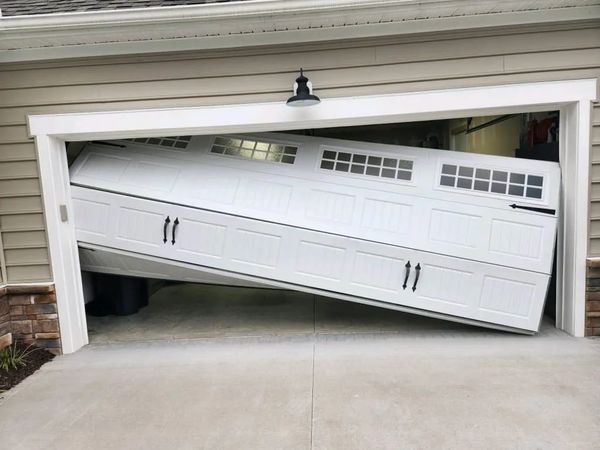
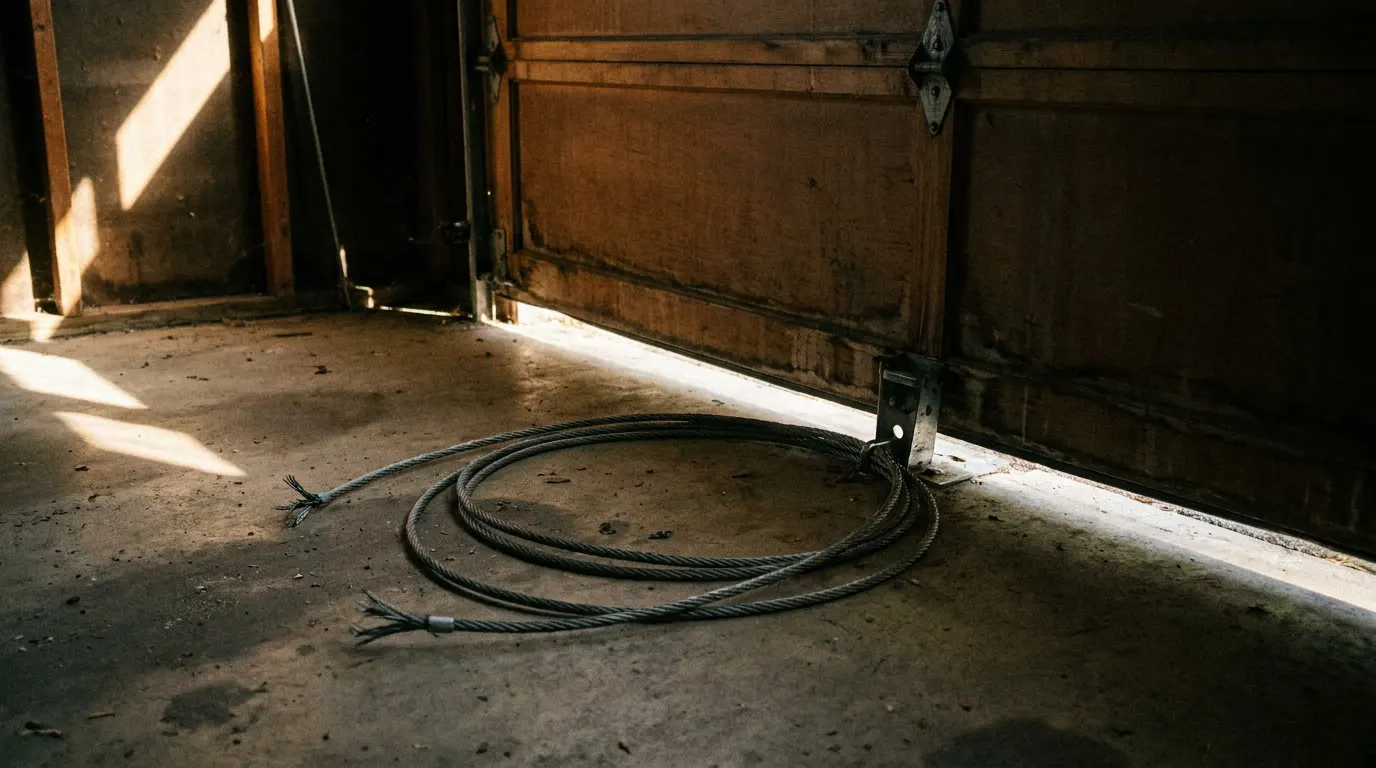
A garage door cable is a steel wire rope that runs from the bottom bracket at the base of the door, upward through a cable drum mounted to the torsion shaft above the door. When you close the door, the cable winds onto the drum; when you open it, the cable unwinds and the spring tension takes the weight. When a cable breaks, one corner of the door loses its lift support entirely - and the door hangs unevenly with the full weight resting on the opener carriage and the surviving cable.
This is one of the more serious garage door failures, and it requires a specific response. Here's what to know.
What Causes Garage Door Cables to Break?
A broken spring is the #1 cause. When a torsion spring snaps, the door drops abruptly. The sudden shock load - 200+ lbs with no counterbalance - is far beyond what the cable was designed to absorb in a single instant. This causes the cable to either snap immediately or develop a severe kink. If your spring broke and you're wondering why the cable also needs replacement: this is why. The two failures are linked.
Cable wear and fraying. Over time, the steel wires in the cable flex over the cable drum thousands of times. Individual wires begin to break - first one or two, then more, until the cable frays visibly or snaps entirely. This is normal end-of-life wear and happens faster in South Florida's salt air environment, which corrodes the individual wires and weakens the cable faster than cycle wear alone.
A vehicle impact. Backing into the garage door - even at low speed - can kink or break a cable, particularly the bottom section near the bracket. The cable is designed to handle the door's weight on a predictable vector; a sudden horizontal force from a vehicle is outside its design parameters.
Cable coming off the drum. Sometimes the cable doesn't break - it slips off the drum groove. This can happen if the spring tension is uneven (the drum unwinds more than intended), if a cable loop at the bottom bracket pulls out, or during an off-track event where the door panel shifts sideways. The result looks similar to a broken cable: the door hangs unevenly on one side. This is actually a simpler repair than a true cable replacement but requires the same careful handling.
The Danger: Why You Shouldn't Operate or Touch the Door
With one cable broken, the door has no balanced support. If you try to operate the opener, the motor applies force to an unbalanced door - which can bend the track, strip the drive gear, or cause the door to jam at a point where it can't be easily recovered. Worse, if the opener disengages (as it's designed to do under excessive load), the door can drop suddenly from whatever height it's at.
The opener is not a safety mechanism - it's designed to move the door, not hold it. A door under load can drop 7 ft to the floor in less than a second. Don't try to manually lower a door with a broken cable unless you can verify the spring is still intact and can fully support the weight unassisted. Even then, use a helper and don't put yourself under the door.
If the door is stuck open (which is common - the opener stops when it detects an imbalance), leave it in place if your car is outside. Block access to the garage from inside the home and call for service. If your car is trapped inside, there's a safe procedure for disconnecting the opener and manually lowering the door with an assistant - a technician can walk you through it over the phone if needed.
What Gets Replaced in a Cable Repair
Cable repairs are almost never cable-only jobs. Here's what a proper repair includes:
- Both cables. If one cable failed, the other has the same wear history. Replacing only the broken one leaves you with a mismatched cable set - the new cable is stiffer, and the difference in flex creates uneven load on the door. Always replace in pairs.
- Inspection and often replacement of the spring. If the cable broke because a spring broke, the spring must be replaced too. A cable repair on a broken spring is incomplete and unsafe - the door will drop again without counterbalance.
- Bottom brackets. The bottom bracket anchors the cable loop at the base of each door panel. If the bracket is bent, cracked, or the loop anchor has pulled through, replace the bracket. This is a safety-critical component.
- Cable drum inspection. The drum should show even wear grooves. Grooves that are cut too deep or damaged by the cable slipping under shock load should be flagged.
How the Repair Works (What to Expect on a Service Visit)
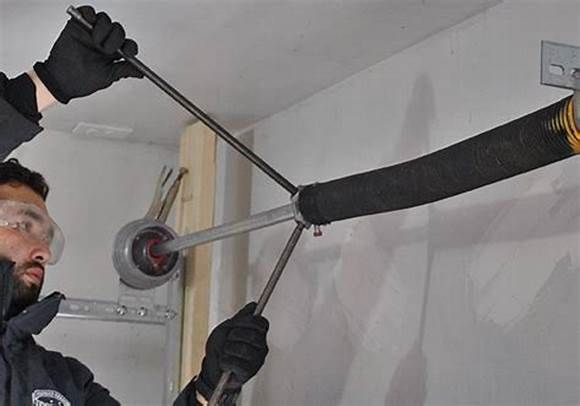
A tech will first relieve tension from the spring system before touching anything - this is the safety-critical step that separates a trained tech from a DIY attempt gone wrong. With tension relieved, the door can be lowered safely, the broken cable removed, new cables routed through the brackets and drums, and tension re-applied in a controlled sequence using winding bars.
The whole job typically takes 45 - 90 minutes for a standard two-cable replacement with an intact spring. If the spring also needs replacement, add another 30 - 45 minutes. Door balance is verified at the end - the tech disconnects the opener and confirms the door holds position at mid-height before reconnecting.
Cost: $150 - $350 for cable replacement alone, $350 - $550 if spring replacement is also needed. For a complete view of what repair types cost, see our cable and off-track repair page and our South Florida repair cost guide.
Can You DIY a Garage Door Cable?
Technically yes - cable replacement without also replacing the spring is mechanically straightforward. The serious risk is with the spring: if the spring is even partially under tension (which it often is even on a "broken" spring), handling the cable drum without properly relieving that tension first can cause the drum or winding cone to release violently. This is the mechanism behind most garage door DIY injuries. If you're certain the spring is fully broken and has released all its tension, cable replacement is lower-risk. If there's any uncertainty about spring tension, call a technician.
-
Stop using the door immediately. Don't run the opener - the motor applies force to an unbalanced door and can cause a sudden drop. If the door is stuck open, leave it in place, block access from inside the home, and call for service. If your car is trapped inside, a technician can walk you through a safe manual lowering procedure with a helper.
-
Cable replacement runs $150 - $350 for both cables (always replace in pairs). If the cable broke because a spring also broke, the spring needs replacement too, bringing the total to $350 - $550. Labor includes safety inspection, spring tension management, cable routing, and a balance test at completion.
-
Yes. The two lift cables share the same wear history. A new cable and a worn cable have different flexibility - the mismatch creates uneven load on the door panel. Always replace both cables at the same time, even if only one is visibly broken.
-
When a torsion spring snaps, the door drops abruptly under its full weight with no counterbalance. The shock load of 200+ lbs on a cable designed for gradual lifting - not sudden drops - commonly causes the cable to snap, kink, or jump off the drum. The two failures are typically linked, and both must be addressed together.
-
Cable replacement on a door with a fully broken, fully released spring is lower-risk and within reach of a mechanically capable homeowner. The serious danger is spring tension: if any tension remains in the spring system, handling the cable drum near the winding cone can cause a violent release. When in doubt, call a professional - this is not the repair category to guess on.
Skip the YouTube rabbit hole - we'll have a tech at your door same day across Broward, Dade and Palm Beach.