A garage door that won't move is one of the most frustrating household problems - especially when it has your car trapped inside or you're late for work. The good news: about one-third of all "won't open" calls turn out to be something the homeowner can resolve in under a minute. Here's how to narrow it down before calling a technician.
1. Broken Torsion or Extension Spring
This is the #1 cause of a garage door that suddenly won't open. The spring counterbalances the weight of the door; without it, the opener motor can't lift 200+ lbs. Signs: the opener hums but nothing moves, the door feels like dead weight when you try to lift it manually, or you heard a loud bang from the garage.
What to do: Look at the spring above the door (torsion: horizontal, centered) or along the track (extension: along the sides). A visible gap in the coil means it broke. Do not try to use the door. A broken spring means zero counterbalance - the full weight of the door can drop suddenly. Call a technician. Spring repair is typically a same-day job.
2. Dead or Disconnected Opener
If the opener motor doesn't respond at all - no light, no sound, no hum - check the basics first: power outlet (unplug and plug something else in), GFCI outlets nearby that may have tripped, and whether a circuit breaker flipped. Opener circuit boards can also fail without warning, especially after a power surge.
What to do: Reset any tripped GFCI, check the breaker, and try the wall button (not just the remote). If none of those fix it, the opener needs diagnosis. See our opener repair page for more.
3. Safety Sensor Obstruction or Misalignment
Photo-eye sensors at the base of your door opening (the small amber/green LED boxes on each side) use an infrared beam. If anything breaks the beam - a leaf, a garden hose, a child's toy, even a cobweb in certain light angles - the door won't close. In Florida's heat and humidity, sensor misalignment is also extremely common: the plastic mounts warp slightly, knocking the sensors out of alignment.
What to do: Both sensor LEDs should be solid (not blinking). Clear any physical blockage. If one LED is blinking, bend the sensor bracket gently until both lights go solid. If the door closes fine with the wall button but not the remote, the problem is usually the remote, not the sensors.
4. Snapped Cable or Off-Track Door
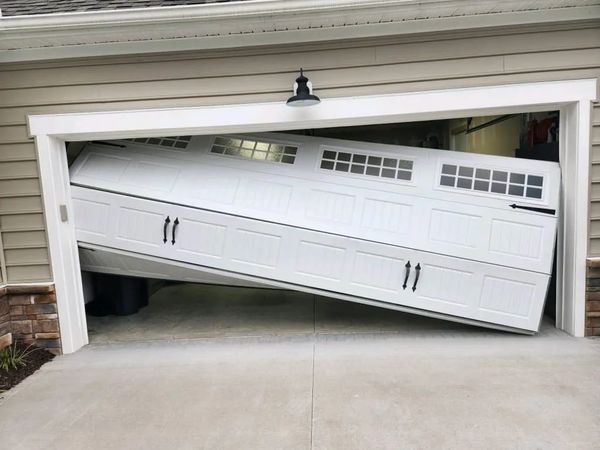
Lift cables run from the bottom bracket of each door panel, up through cable drums, and wrap around a shaft above the door. A snapped cable (often caused by a broken spring or a vehicle bump) or a door that jumped off track will leave the door stuck in place - or worse, hanging at an angle.
What to do: If the door is visibly off-track (hanging at an angle, panels not aligned) or a cable is coiled on the floor, don't run the opener. The door can fall. Manual operation is also unsafe until it's re-railed. Our team handles off-track and cable repair as a same-day emergency service.
5. Stripped Drive Gear in the Opener
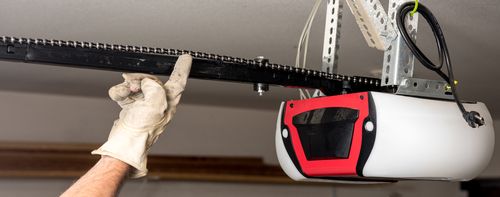
Chain and belt drive openers have a plastic drive gear that meshes with the motor sprocket. Over time - especially in South Florida heat - this gear can strip or crack, causing the motor to run but the chain or belt to slip. The sound is distinctive: the motor runs normally but you hear grinding or slipping, not movement.
What to do: This is a repair, not a replacement - a drive gear kit typically costs $40 - $80 in parts, plus labor. Worth doing if the opener is otherwise in good shape and under 10 years old.
6. Dead Remote Batteries or Frequency Interference
Sounds obvious, but dead batteries account for a surprising number of service inquiries. South Florida's heat accelerates battery discharge - batteries that would last 2 years in a cooler climate may only last 12 - 18 months here.
What to do: Replace the remote battery with a fresh one. If the wall button works but the remote doesn't (with fresh batteries), the remote or the opener's antenna may need attention. A rare but real issue: LED bulbs installed in the opener itself can interfere with the radio frequency in some opener models - try a different bulb type if the problem started after an LED swap.
7. Manual Lock Engaged
Many garage doors have a manual slide lock or T-bar lock in the center of the door. If it's engaged, no opener or physical force will move the door. This sometimes gets engaged accidentally by children or during a break-in attempt.
What to do: Look at the center horizontal bar of the door from inside the garage. If there's a slide bar extended into the door track, disengage it. The opener will work normally after.
8. Limit Settings Out of Adjustment
Openers have "close" and "open" limit settings that tell the motor when to stop. If these drift - often after a power surge or if someone adjusted them - the door may stop short, reverse immediately after closing, or refuse to open all the way. Signs: the door stops a few inches from fully closed, or it closes and then immediately reverses.
What to do: Limit adjustments are usually two screws on the opener body labeled UP and DOWN. Consult your opener's manual for the exact adjustment direction. If the door reverses immediately on close, the down-force setting may also be too sensitive - check both limit and force settings together.
9. Disconnect Cord Pulled
Every opener has a red emergency disconnect cord hanging from the trolley. If someone pulled it (common during a power outage), the trolley is disengaged from the carriage and the opener runs but doesn't move the door.
What to do: With the door fully closed, pull the cord toward the door (not straight down) to re-engage the trolley. You'll feel and hear a click when it reconnects. Then run the opener normally - it will re-engage automatically on the first cycle.
When to Call a Technician
Call immediately for: broken spring (any kind), snapped or coiled cable, door off-track, visible structural damage, or any situation where the door is stuck partway open and you can't secure your home. These are emergency garage door repair situations - don't try to work around them with a car blocking the opening or manually propping the door.
Call for a scheduled visit for: opener drive gear, limit adjustments, sensor replacement, or anything where the door is still functional but behaving erratically.
-
The most common causes when the motor runs but the door doesn't move: broken spring (door too heavy for the motor to lift), stripped drive gear (motor slips), or a disconnect cord that was pulled and hasn't re-engaged. Check for a visible gap in the torsion spring above the door first.
-
The most common cause is a safety sensor issue: one or both photo-eye sensors at the base of the door are blocked, misaligned, or dirty. Both sensor LEDs should be solid (not blinking) for the door to close. Also check for a manual slide lock engaged on the door itself.
-
Either the close-limit setting is too far out (telling the motor the door isn't fully closed yet) or the down-force sensitivity is set too high (triggering the auto-reverse as if something is in the way). Both are adjustable on the opener body. Consult your opener's manual for the exact screw locations.
-
No. A door with a broken spring has no counterbalance - you're lifting the full weight of the door (150 - 300 lbs for most residential doors) with no mechanical assistance. The risk of losing control and dropping the door on yourself or your vehicle is significant. Leave it in place and call for spring repair.
-
It depends on the cause: remote battery swap ($0), sensor realignment ($75 - $150), limit adjustment ($75 - $150), drive gear replacement ($200 - $300), spring replacement ($250 - $450), cable repair ($150 - $350). A diagnosis call (typically $75 - $100) applies toward repair if you proceed.
Skip the YouTube rabbit hole - we'll have a tech at your door same day across Broward, Dade and Palm Beach.