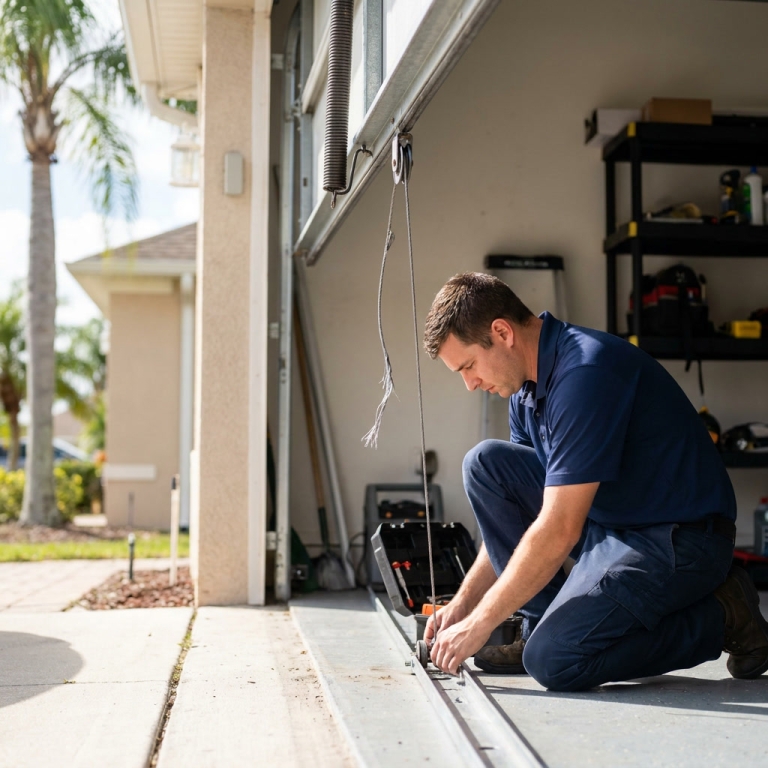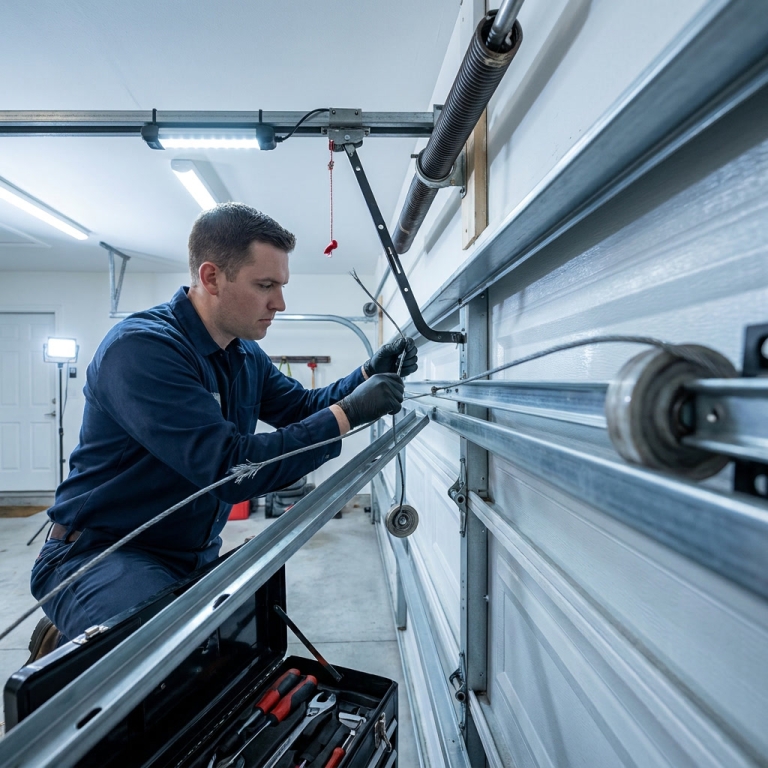
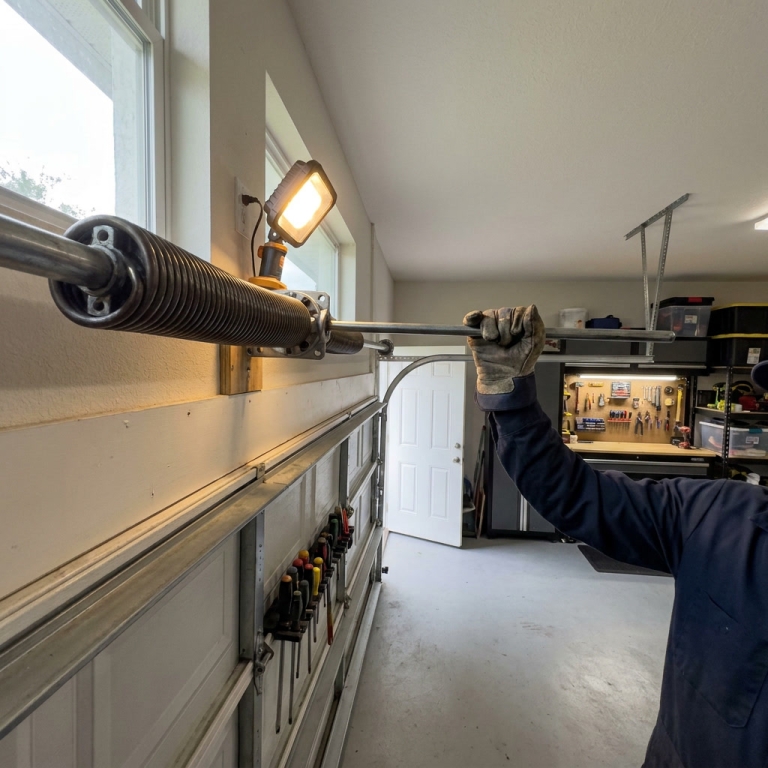
A broken garage door spring can turn an ordinary day into a serious inconvenience. One moment, your garage door is working normally; the next, the door may refuse to open, close unevenly, become extremely heavy, or make a loud snapping sound. For Florida homeowners, the obvious question is: how much does spring repair cost in Florida?
In most cases, homeowners can expect to pay approximately $150 to $450 for a standard garage door spring repair. However, the final price can be higher or lower depending on the spring type, door size, labor requirements, access to the spring, the condition of the garage door, emergency scheduling, and whether additional components must be replaced. Torsion spring replacement often costs more than a basic extension spring repair because of the equipment, adjustment, and safety procedures involved.
Florida homeowners also face conditions that can affect garage doors differently than homeowners in other states. High humidity, salt air, intense heat, tropical storms, hurricanes, heavy rain, and frequent temperature changes can contribute to corrosion and premature wear. If your garage door is located near the coast, the spring may deteriorate faster than expected. A professional inspection can determine whether the problem is limited to the spring or connected to cables, rollers, drums, hinges, tracks, or the opener.
This comprehensive guide explains typical Florida spring repair prices, the difference between repair and replacement, the factors that influence an estimate, and ways to prevent future breakdowns. It also explains when a spring issue requires emergency garage door repair and how to select a dependable local provider.
Typical Garage Door Spring Repair Costs in Florida
The cost of a garage door spring repair in Florida generally falls into several pricing categories. A straightforward repair during regular business hours may cost between $150 and $300. A more involved torsion spring replacement, especially on a heavy or oversized door, commonly ranges from $250 to $450. Double garage doors, high-lift systems, custom doors, and doors requiring multiple springs can cost more. Emergency appointments, weekend service, and after-hours calls may add approximately $50 to $150 depending on the company and timing.
These figures are general estimates rather than guaranteed quotes. Every garage door system is different. A small single-car door with one accessible spring may be inexpensive to service, while a large insulated double door with two broken springs, damaged cables, and worn bearings can require substantially more labor and materials. A reputable company should inspect the entire system before recommending work and explain the price clearly.
Homeowners should also understand that “spring repair” can mean different things. In some cases, a technician adjusts spring tension, replaces a minor component, or corrects an installation problem. In other cases, the spring has permanently lost its strength or has snapped and must be replaced. Springs are highly tensioned components, so a complete replacement is often the safest and most reliable solution.
Common Florida price ranges include:
- Extension spring adjustment or minor repair: approximately $100 to $250.
- Single torsion spring replacement: approximately $200 to $350.
- Two torsion spring replacement: approximately $300 to $500 or more.
- Heavy-duty or oversized garage door springs: approximately $350 to $650.
- Emergency, weekend, or after-hours service: often an additional $50 to $150.
- Spring repair combined with cable, roller, or bearing replacement: commonly $350 to $800 depending on the parts required.
Some companies advertise very low spring replacement prices, but homeowners should be cautious when the estimate seems far below the local average. The quote may exclude labor, trip charges, disposal fees, balancing, safety testing, or replacement of both springs when the system requires a matched pair. A low initial price can become expensive if the work is incomplete or if the wrong spring is installed.
It is also important to ask whether the quote includes a warranty. Many professional providers offer a workmanship warranty and a manufacturer warranty on replacement springs. The length of coverage varies, but a written warranty provides confidence that the company stands behind its installation. Ask whether the warranty covers the spring only or also includes labor and related components.
For homeowners comparing broken spring repair estimates, the best approach is to compare the complete scope of work rather than a single advertised price. Confirm the spring type, number of springs, cycle rating, labor, service fees, warranty, safety inspection, and final total. A transparent estimate helps prevent misunderstandings and makes it easier to choose a qualified professional.
Why Garage Door Spring Repair Prices Vary
Garage door springs are not universal parts. They are selected according to the weight, height, width, construction, and operating system of a garage door. The technician must use a spring with the correct dimensions and lifting capacity. Installing an incorrect spring can cause the door to open too quickly, close too heavily, remain unbalanced, or place additional stress on the opener and other hardware.
The first major factor is spring type. Most residential systems use either torsion springs or extension springs. Torsion springs are mounted horizontally above the garage door and use controlled twisting force to lift the door. Extension springs are positioned along the horizontal tracks and stretch as the door moves. Torsion systems are often more durable and provide better balance, but their replacement usually requires more specialized knowledge and tools.
The number of springs also affects the price. A narrow single-car garage door may use one spring, while a wider double-car door may use two or more. If one spring breaks on a two-spring system, many technicians recommend replacing both at the same time. The second spring may be close to the end of its service life, and replacing only one can create an imbalance between the sides of the door.
Door weight is another major consideration. Insulated steel doors, wooden garage doors, impact-resistant doors, and hurricane-rated garage doors can be significantly heavier than basic non-insulated doors. Florida homeowners who have reinforced doors designed to resist wind pressure should make sure the replacement spring is rated for the exact system. A standard spring may not be suitable for a wind-rated or high-cycle door.
Several additional issues can increase the final price:
- Corrosion: Salt air and moisture can weaken springs, cables, brackets, and bearings.
- Restricted access: A crowded garage or unusual ceiling configuration can make the work more time-consuming.
- Damaged cables: A broken spring may allow the lift cables to come off the drums or become frayed.
- Worn rollers and hinges: Excessive friction can make the spring work harder and shorten its useful life.
- Damaged drums or bearings: These parts may need replacement if they are bent, noisy, or excessively worn.
- Door imbalance: The technician may need to reset the system and test the force several times.
- Limited availability: Unusual spring dimensions may need to be ordered rather than installed immediately.
Service timing can also affect cost. During normal weekday hours, a company may charge its standard labor rate. Nights, holidays, weekends, and emergency calls generally involve additional dispatch costs because the technician must respond outside the regular schedule. Even so, emergency service can be worthwhile when the door blocks your vehicle, leaves the garage unsecured, or creates a safety hazard.
Florida location matters as well. Prices in Miami, Fort Lauderdale, Boca Raton, West Palm Beach, and other South Florida communities can vary according to travel distance, local demand, and the complexity of the property. A company serving coastal neighborhoods may regularly work with corrosion-resistant hardware and reinforced systems, while a provider farther inland may have different inventory and pricing.
A professional estimate should include more than “spring replacement.” It should identify the door size, spring type, number of springs, expected cycle rating, related parts that require attention, labor, warranty, and any applicable service or emergency fee. Homeowners should be wary of technicians who quote a final price without inspecting the door or who pressure them into approving unrelated work.
Spring Repair Versus Spring Replacement and Other Garage Door Services
Many homeowners use the terms spring repair and spring replacement interchangeably, but the work may be different. A spring that has snapped cannot be restored to its original strength through lubrication or adjustment. It must be replaced. A spring that is still intact may sometimes be adjusted if the door is slightly out of balance, although adjustment is appropriate only when the spring remains in good condition and is correctly sized.
Springs have a limited service life measured in cycles. One cycle usually means the door opens and closes once. Standard residential springs may be rated for approximately 10,000 cycles, while upgraded springs may be rated for 20,000, 25,000, or more cycles. A household that uses its garage door several times each day may reach the spring’s expected life sooner than a household that uses it only once or twice daily.
There are several warning signs that a spring may be failing. The door may feel unusually heavy when operated manually, rise only a few inches, close too quickly, or appear crooked. You may see a visible gap in the spring, hear a loud bang from the garage, notice loose cables, or find that the automatic opener hums without lifting the door. A spring problem can also make the opener appear defective even when the opener is working properly.
Never attempt to remove or adjust a high-tension spring without professional training. The stored energy can cause severe injuries to hands, arms, face, or body. Using the wrong winding bars, standing in the wrong position, or loosening the wrong fastener can release energy suddenly. Homeowners can safely observe symptoms and disconnect the opener in an emergency, but spring replacement should be handled by a qualified technician.
During a spring appointment, the technician should inspect the complete door system. This may include:
- The torsion or extension springs and their mounting points.
- Lift cables, drums, pulleys, and bottom brackets.
- Tracks, rollers, hinges, and end bearings.
- The door panels, weather seal, and structural hardware.
- The opener rail, drive mechanism, safety sensors, and emergency release.
- Door balance, travel limits, reversing force, and overall operation.
In some cases, the spring is not the only problem. For example, a cable may have frayed because the door was operating unevenly for months. A damaged roller may have increased resistance and placed extra load on the spring. A worn center bearing may create grinding noises and excessive movement. Repairing only the visible spring without addressing the underlying issue can lead to another breakdown soon afterward.
Spring work may also be scheduled alongside other services. Homeowners completing a renovation may compare spring repair with garage door installation if the existing door is badly damaged, outdated, or inefficient. A new door may be more practical when panels are cracked, hardware is obsolete, or repair costs approach the value of replacement.
Florida weather can influence that decision. If a garage door has suffered storm damage, replacement may be necessary to restore structural integrity and meet current local requirements. Some homeowners choose hurricane-rated garage doors for improved resistance to high winds and flying debris. These systems can require specific tracks, reinforcement, brackets, and spring configurations, so they should be serviced by a provider familiar with wind-rated installations.
The opener should also be evaluated. A new spring can restore the door’s balance, but an old motor may still struggle if it is worn, improperly adjusted, or incompatible with the door. If the opener has a failing gear, damaged circuit board, weak motor, or unreliable sensors, the homeowner may need garage door opener repair as a separate service. A technician can determine whether the opener needs adjustment, repair, or replacement.
Florida-Specific Factors, Maintenance, and Long-Term Costs
Florida’s climate creates special challenges for garage door systems. High humidity can encourage rust on unprotected metal components, while coastal salt air accelerates corrosion. Heavy rain can enter through damaged weather seals, and intense sunlight can cause certain plastics and rubber components to deteriorate. During hurricane season, wind pressure and flying debris can place extreme stress on the garage door, tracks, rollers, hinges, and reinforcement hardware.
Routine garage door maintenance is one of the most effective ways to reduce unexpected spring expenses. A professional maintenance visit typically includes a visual inspection, lubrication of appropriate moving parts, tightening of accessible hardware, testing of safety features, adjustment of the door balance, and evaluation of the opener. Maintenance does not make springs last forever, but it can reveal wear before a sudden failure and help prevent small problems from becoming major repairs.
Homeowners can perform a few basic observations between professional visits. Look at the springs for visible gaps, rust, deformation, or unusual stretching. Check whether the door moves smoothly and evenly. Listen for scraping, grinding, popping, or squealing noises. Examine the lift cables for fraying, but do not touch them if they appear loose or disconnected. Test the photo-eye sensors by placing an appropriate object in the doorway and confirming that the door reverses safely.
Do not lubricate every part indiscriminately. Some components require a garage-door-specific lubricant, while others should remain dry. Grease on tracks can attract dirt and cause rollers to drag. Spraying lubricant directly onto a spring may not solve a structural problem and can create a false impression that the component is safe. A technician can recommend suitable products and explain which parts should be lubricated.
Additional maintenance steps include:
- Keep the area around the garage door tracks clear of stored items.
- Remove leaves, sand, and debris from the floor near the bottom seal.
- Inspect the weather seal for gaps, cracking, or hardening.
- Keep the safety sensor lenses clean and properly aligned.
- Secure loose brackets and visible hardware only when it is safe to do so.
- Schedule an inspection after severe storms or visible impact damage.
- Avoid repeatedly operating a door that is crooked, unusually heavy, or noisy.
Smart technology can also affect long-term convenience and service planning. Smart garage door openers allow homeowners to check door status, receive alerts, create access schedules, and operate the door through a mobile application. These systems are useful for families, rental properties, and homeowners who want to monitor access while away from home. However, smart features do not eliminate mechanical maintenance. The springs, cables, rollers, tracks, and panels still require regular inspection.
When comparing garage door maintenance plans, ask what is included. Some plans cover only lubrication, while others include balance testing, safety inspection, hardware tightening, opener evaluation, and priority scheduling. A maintenance plan may be especially useful for homes with older doors, high daily usage, coastal exposure, or multiple vehicles that depend on reliable garage access.
Insurance and storm considerations should also be reviewed. A damaged garage door can expose the home to water, wind, pests, and theft. After a hurricane or tropical storm, do not force a door open if the panels, tracks, or reinforcement hardware are visibly damaged. Photograph the damage, keep receipts for emergency work, and contact your insurance provider if appropriate. A professional can advise whether the door is safe to operate or requires temporary securing.
Long-term costs often become lower when homeowners address problems early. Replacing a worn roller may cost far less than repairing a bent track after the roller fails. Replacing a damaged weather seal may help protect hardware from moisture. Installing a properly rated spring can reduce strain on the opener. Investing in maintenance and timely repairs is generally more economical than waiting for a complete system failure.
How to Choose a Florida Garage Door Company and Avoid Overpaying
Choosing the right provider is just as important as understanding the price. A qualified technician should have experience with residential garage doors, torsion and extension spring systems, wind-rated doors, openers, and the local conditions that affect Florida properties. Look for clear communication, professional identification, proof of insurance, written estimates, and a reasonable workmanship warranty.
Search results may show many companies offering South Florida garage door services, but not every provider offers the same level of training or customer care. Before scheduling, ask whether the company serves your specific city, carries common replacement springs, provides same-day service, and has experience with your door brand or configuration. You can also ask whether the technician will inspect cables, drums, rollers, bearings, tracks, and opener safety features rather than replacing only the broken component.
Homeowners in the region may need a Broward County garage door company for homes in Fort Lauderdale, Hollywood, Pembroke Pines, Coral Springs, Davie, Plantation, Weston, or nearby communities. In Miami, Hialeah, Homestead, Doral, Kendall, and surrounding areas, customers may search for Miami-Dade garage door services. Local experience can be valuable because technicians understand common construction styles, coastal exposure, hurricane preparation, and municipal expectations.
A trustworthy estimate should answer several questions before work begins:
- What type of spring does the door use?
- How many springs need to be replaced?
- What is the spring’s expected cycle rating?
- Are cables, drums, bearings, rollers, or brackets damaged?
- Is the quoted price inclusive of labor and service fees?
- Does the estimate include balance testing and safety inspection?
- What warranty applies to parts and workmanship?
- Will the technician remove the old springs and clean the work area?
- Will emergency, weekend, or after-hours charges apply?
Be careful with companies that use high-pressure sales tactics. A spring failure does not automatically mean that the entire garage door must be replaced. Likewise, a technician should not recommend expensive upgrades without explaining the reason, expected benefit, and alternatives. Ask for photographs of damaged parts when possible and request a written explanation if additional repairs are proposed.
Reviews can help, but they should be evaluated thoughtfully. Look for consistent comments about punctuality, accurate pricing, workmanship, professionalism, and follow-up support. A large number of reviews is useful, but the most important issue is whether recent customers describe work similar to the service you need. A provider with experience repairing a standard door may not be the best choice for a heavy custom door or hurricane-rated system unless the company specifically handles those installations.
Emergency availability is another important consideration. A door that will not close can leave your belongings and vehicles exposed, while a door that will not open can prevent you from leaving for work or accessing essential items. A broken spring can also create a dangerous imbalance. If the door is stuck, crooked, making loud noises, or has loose cables, avoid using the opener and contact a professional. Same-day emergency service may cost more than a routine appointment, but it can restore security and prevent further damage.
For homeowners who need dependable service in Broward County, the company description is straightforward: Need emergency garage door repair near me in Broward County, Florida? Same-day service, 13+ years experience, 450+ five-star reviews. Call (954) 830-9661. This type of local availability can be especially helpful when a spring breaks before a storm, after a vehicle impact, or late in the day when regular appointments are unavailable.
Before approving the job, confirm the total price and payment options. Ask whether there is a minimum service charge, whether the warranty is written, and whether the technician will test the door after installation. Once the work is complete, the door should open and close smoothly, remain balanced when manually operated, reverse when the safety sensors are interrupted, and stay securely closed.
In summary, most Florida garage door spring repairs cost approximately $150 to $450, although heavy doors, multiple springs, corrosion, related damage, custom hardware, and emergency scheduling can increase the total. The most reliable way to control costs is to obtain a complete written estimate, repair related problems at the same time, and schedule regular inspections before a spring fails unexpectedly.
Do not attempt to handle a high-tension spring yourself. If your garage door is stuck, crooked, unusually heavy, or making a loud snapping sound, stop operating it and call a qualified local technician. For prompt help in Broward County, call (954) 830-9661 for same-day service from an experienced team with 13+ years of experience and more than 450 five-star reviews.
Skip the YouTube rabbit hole - we'll have a tech at your door same day across Broward, Dade and Palm Beach.