Short answer: A broken garage door spring should never be DIY-repaired — torsion springs store 300-400 pounds of energy that can release violently and injure or kill. Call a pro: the repair runs $250-$450 for a standard residential door, takes 45-90 minutes, and includes a balance test and 1-year warranty. If you absolutely insist on DIYing, you need winding bars, eye protection, a safe lockout procedure, and a willingness to bet your hands on getting it right.
How to tell your garage door spring is broken
Four telltale signs you have a broken spring:
- You heard a loud bang from the garage. Springs fail under tension — the snap sounds like a small firecracker, sometimes louder.
- The door won't lift, or lifts only a few inches and then the opener stops with a strain noise.
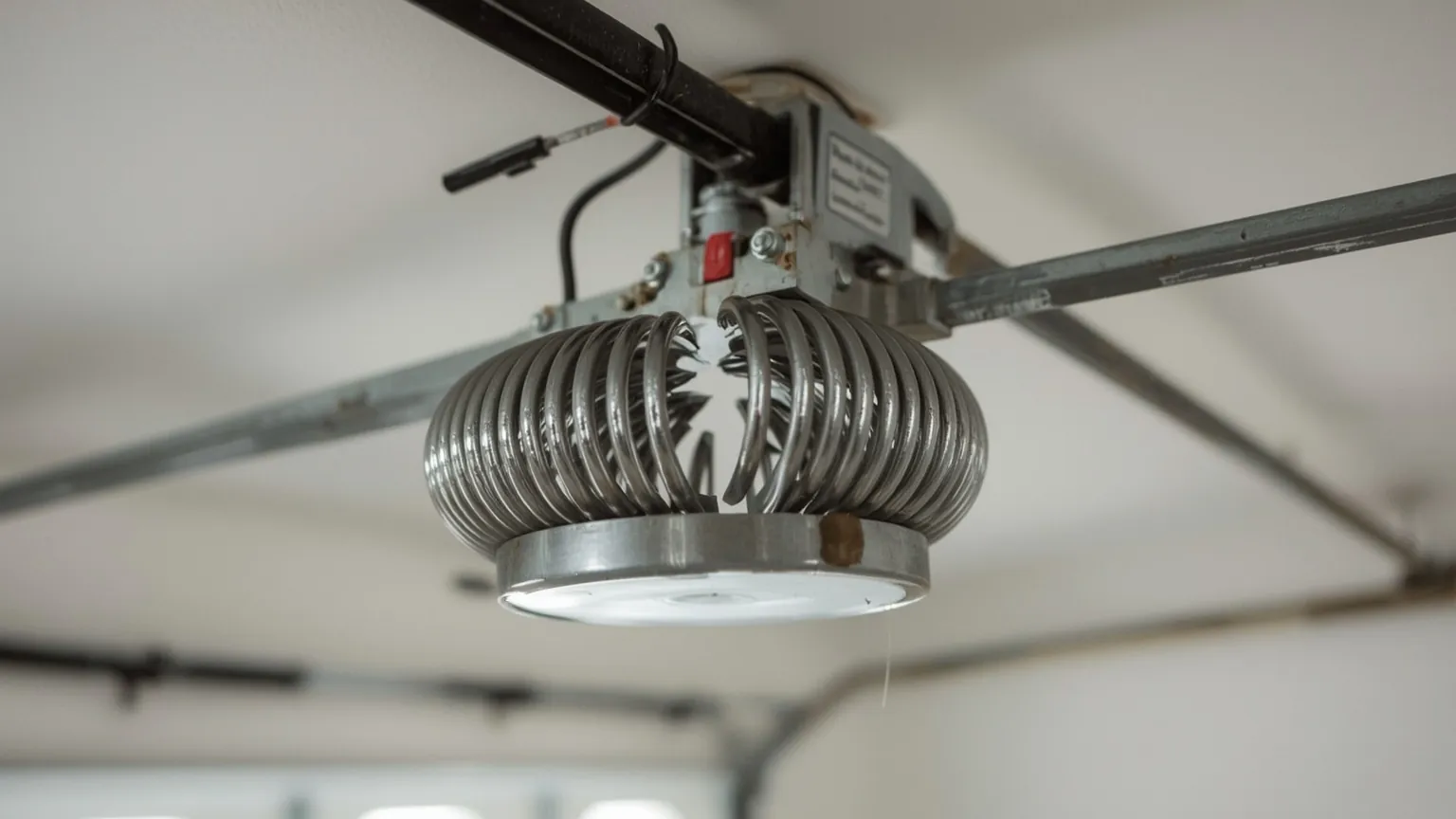
- There's a visible gap in the spring when you look at the horizontal bar above the door. A continuous tight coil = intact. A gap of an inch or more = broken.
- The door slams shut rather than lowering gently. This is the spring's counterbalance gone — gravity now wins.
If any of these match, don't operate the door manually. A door with a broken spring weighs 150-250 pounds with no counterbalance. Lifting it by hand can hurt you or destroy the opener motor.
Why a broken garage door spring is dangerous to DIY
A residential torsion spring stores 300-400 pounds of tension. The spring is wound onto a steel shaft above the door, and the only thing keeping that energy contained is the bearing and the set screws on the winding cones. When you replace a broken spring, you have to:
- Wind the new spring under that tension using a pair of winding bars (not screwdrivers — every year, ER visits trace back to people using screwdrivers).
- Hold the tension while you tighten the set screws on the winding cone — if you slip, the spring releases all that energy in your direction.
- Balance the door (it should stay halfway open by itself when you let go).
- Check the lift cables, drum sizing, and bearings — wrong drum size or worn bearings cause the new spring to fail in months.
Roughly 30,000 emergency-room visits per year in the US trace back to garage door spring DIY attempts. The skill required is real, and the savings vs a professional repair is only $80-$150 of labor. Not worth the trip.
How a pro replaces a broken garage door spring
Here's what the professional process looks like:
- Diagnostic. Tech arrives, disconnects the opener, locks out the door, photographs the existing spring assembly.
- Measurement. Three numbers matter: wire gauge (typically .192" to .250"), inside diameter (typically 1-3/4" to 2-1/4"), and length. Wrong on any of these = wrong spring.
- Replace in pairs (recommended). If both springs are over 5 years old, replace both at once. The matched spring almost always fails within 6 months otherwise, and the second service call costs you another $80-$150 in trip fees.
- Wind to spec. Each spring has a turn count specific to its wire/IDL/length combination — usually 7-8 quarter turns for a 7-foot door. Wound with proper winding bars, gloves, and eye protection.
- Hardware refresh. Bearings and end cones inspected; replaced if showing wear. Lift cables checked for fraying.
- Balance + safety test. Door should stay halfway open by itself (counterbalance check). Safety-reverse on the opener tested with a 2x4. Final cycle test, written invoice, gone.
What a broken spring repair actually costs in 2026
| Job | Typical South Florida price |
|---|---|
| Single spring replacement | $250-$350 |
| Dual spring replacement (recommended over 5 yrs) | $350-$450 |
| Heavy-duty / oversize spring (carriage, 18'+ doors) | $450-$650 |
| Spring + cables + drums combo | $400-$600 |
| Emergency / after-hours service add-on | +$75-$150 |
Prices include the spring(s), labor, hardware that needs replacing, balance test, and a 1-year warranty. Reputable companies quote in writing before any work begins.
How to prevent broken springs in the future
- Annual maintenance. $79-$129 for a tune-up that lubricates the springs, checks balance, and replaces worn bearings. Doubles spring life on average.
- Replace in pairs. Don't wait for the second spring to fail — schedule the matched replacement at the 7-year mark.
- Upgrade to high-cycle springs. Standard residential springs are rated 10,000 cycles. High-cycle springs (20,000+) cost $50-$100 more per spring but last 2-3x longer — worth it for households cycling 6+ times per day.
- Don't ignore noise. Squeaking, clicking, or grinding springs are within 6 months of failure. Cheaper to replace before they break than after.
FAQs about broken garage door springs
Can I just leave a broken spring and not fix it?
No. A door with one broken spring is unsafe to operate. The remaining spring is now carrying double load and will fail within weeks-to-months. The opener motor is straining and will burn out. And manual operation is dangerous.
How long does a broken spring repair take?
45-60 minutes for single spring, 75-90 minutes for dual spring + hardware. Most jobs are completed in a single visit.
Can you replace just the broken spring or do I need both?
If both are under 3 years old, you can replace just the broken one. If both are over 5 years old, replace in pairs — the matched spring's fatigue history is identical, and it will fail within 6 months. Pair-replacement adds $100 to the bill upfront but saves $150-$200 in second-trip fees.
Why did my new spring break so fast?
Usually wrong drum sizing or worn bearings stressed the new spring. Reputable installers measure and inspect both before installing the spring. If a spring fails within the warranty period (typically 1 year on labor, 1-5 years on the spring itself), the install is covered.
Are high-cycle springs worth the extra cost?
For most households, yes. Standard 10,000-cycle springs last 4-7 years in South Florida. 20,000-cycle springs cost $50-$100 more per spring and last 8-14 years — they pay back in one cycle of replacement avoidance.
Skip the YouTube rabbit hole - we'll have a tech at your door same day across Broward, Dade and Palm Beach.