Every major garage door opener brand now offers a Wi-Fi-connected "smart" version. The baseline question is whether the connectivity features justify the price premium - which typically runs $100 - $200 over an equivalent non-smart model. For most South Florida homeowners, the answer is yes, but not for the reasons the marketing emphasizes.
What "Smart" Actually Means on a Garage Door Opener
A smart garage door opener connects to your home Wi-Fi and pairs with a smartphone app. The core features across most brands:
- Remote open/close from anywhere. Open for a delivery, let a family member in, or close a door you left open - all from the app. This works as long as your phone has cell or Wi-Fi service and the opener has power and a network connection.
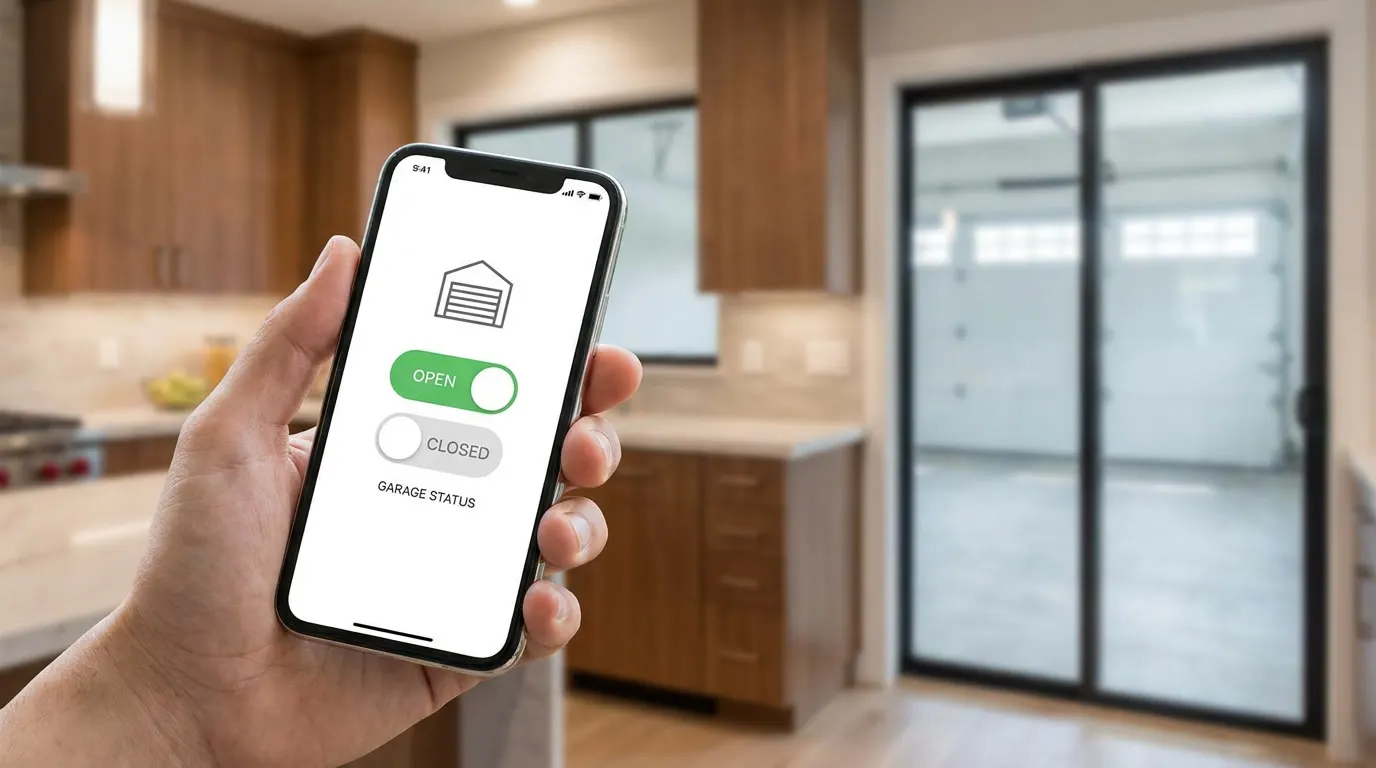
- Real-time status monitoring. See whether the door is open or closed at any time, from anywhere. For people who repeatedly wonder "did I close the garage?" this is the feature that justifies the upgrade on its own for many homeowners.
- Auto-close timer. Set the door to automatically close after a specified period if it's been left open - 10 minutes, 30 minutes, etc. This is available in the app without any additional hardware.
- Activity history. A log of every open/close event with timestamp. Useful for tracking when family members come and go or identifying unusual activity.
- Alerts and notifications. Push notification when the door opens or closes. Some systems alert you only if the door has been open more than X minutes.
Features Worth Paying For vs. Marketing Features
Worth paying for:
- Auto-close. Automatically closes a forgotten open door. In South Florida's afternoon thunderstorm season, a garage left open during a storm can flood in minutes. This single feature has paid for many smart openers in real terms.
- Battery backup integration. Some smart openers integrate battery backup monitoring into the app - you can see the battery's charge level and get notified when it's low. This is more useful than the feature sounds; the backup battery is the first thing that fails quietly in South Florida's heat, and most homeowners don't discover it until the power goes out during a storm and the "backup" doesn't work.
- Smart home integration (if you're already in that ecosystem). If you use Amazon Alexa, Google Home, or Apple HomeKit, a smart opener that integrates natively means you can open the garage with a voice command or include it in routines ("when I arrive home, open the garage"). If you're not in a smart home ecosystem already, this feature matters less.
Mostly marketing:
- Built-in camera. Some models include a camera in the opener head pointing at the garage interior. The camera image quality is typically limited, the field of view is narrow (only the area directly below the motor unit), and it doesn't cover the most security-relevant view (the exterior). A dedicated security camera with a wider field of view gives you more for less money. The exception: if you specifically want a visual confirmation that the door is closed, the camera in a LiftMaster unit does serve that purpose.
- "Works with" badges from 5 platforms. Most openers advertise compatibility with every major smart home platform, but the actual integration depth varies. Check specifically for two-way control (open AND close, not just status display) on the platform you actually use before buying.
Security: Real Concerns vs. Overstated Ones
One question we get from homeowners considering smart openers: "Isn't Wi-Fi control less secure than a physical remote?"
The honest answer: modern smart openers use encrypted communication (TLS, AES-128 or better) between the app and the cloud service, and between the cloud service and the opener. Rolling code technology (which all modern openers use, smart or not) prevents replay attacks where someone records and replays your remote signal. The attack surface of a modern smart opener is comparable to your home's smart doorbell or thermostat - which most people accept without concern.
The security risks that ARE real: a compromised account (use a strong unique password and two-factor authentication on the opener's app account), a shared access that wasn't revoked (guest accounts with temporary codes are a feature of most smart systems - use them instead of sharing your account credentials), and cloud service outages that temporarily prevent remote control (you can always operate the door locally with the wall button or remote).
Retrofit Smart Devices: An Alternative to Full Replacement
If your existing opener is in good condition but lacks Wi-Fi connectivity, retrofit smart devices can add app control without replacing the opener. The myQ Smart Garage Control and similar products add a sensor (detects open/close) and a button controller to your existing opener. The functionality is similar to a built-in smart opener - remote open/close, alerts, auto-close timer.
Cost: $30 - $60 for the device. Setup typically takes under 15 minutes. Limitation: the retrofit device works with most major opener brands but not all (check compatibility for your exact opener model before buying). It also doesn't add battery backup if your opener doesn't have it.
The Florida-Specific Consideration: Battery Backup
Any South Florida homeowner evaluating a smart opener should prioritize models with built-in battery backup. Smart features become meaningless if your opener is dead during the power outage after a hurricane or a thunderstorm. The LiftMaster 84501 and 87504 include battery backup standard. Chamberlain's equivalent models also carry battery backup. Look for this as a required feature, not an optional add-on. See our opener repair and replacement page for installation pricing, and our opener buying guide for the brand and drive-type comparison (smart vs non-smart).
Who Should Get a Smart Opener
- Yes, worth it: Any household where at least one person regularly wonders "did I close the garage?" Households where deliveries are left in the garage. Anyone who gives access to contractors, house cleaners, or family who need to come and go. Smart home users already invested in Alexa, Google, or Apple HomeKit.
- Less clearly worth it: Single-occupant households with consistent routines. People who primarily use the garage for storage and open it rarely. Anyone who already has a reliable keypad and never misses a closure.
For most South Florida attached-garage households, a 3/4-HP belt-drive smart opener with battery backup is our default recommendation - it covers the noise, the outage resilience, the convenience, and the peace of mind in one package. The keyless entry system on the exterior completes the picture for keyless access without phone dependence.
-
For most households, yes. The genuinely useful features - remote open/close from anywhere, real-time open/closed status, auto-close timer, and open/close alerts - solve real daily-life problems. The premium over a non-smart equivalent is typically $100 - $200. South Florida homeowners should prioritize models with built-in battery backup, which is equally important as the Wi-Fi connectivity.
-
Modern smart openers use encrypted cloud communication and rolling code technology, making them substantially more difficult to compromise than older fixed-code remotes. The realistic security risks are account-level (weak password, shared credentials not revoked) rather than signal-interception. Use a strong unique password and enable two-factor authentication on the app account.
-
Yes - retrofit devices like the myQ Smart Garage Control add app-based remote control, real-time status, auto-close, and alerts to most existing openers without full replacement. Cost is $30 - $60. Check compatibility with your specific opener model before buying. These devices don't add battery backup if your opener lacks it built-in.
-
For most South Florida attached-garage installations, a 3/4-HP belt-drive opener with Wi-Fi and built-in battery backup is the best configuration - the LiftMaster 84501 and 87504 are our most-installed models. Battery backup is especially important here given frequent power outages during hurricane season and afternoon storms.
-
Only if it has a built-in battery backup. Standard smart openers lose all function - including local remotes and wall buttons - when power is out. A model with battery backup maintains full operation (including remote and app control via phone data) during outages, typically for 24 - 48 hours.
Skip the YouTube rabbit hole - we'll have a tech at your door same day across Broward, Dade and Palm Beach.