Meta description: Learn how to lubricate garage door hinges and tracks safely, choose the right garage door lubricant, prevent noisy operation, and recognize when professional repair is needed.
A garage door is one of the largest moving systems in a typical home. Every time it opens or closes, hinges flex, rollers travel, springs carry weight, and the door’s hardware shifts under considerable tension. When those components become dry or dirty, the warning signs are hard to miss: squeaking, grinding, rattling, jerking, or a door that seems reluctant to move.
Fortunately, regular lubrication can help keep the system quieter and reduce unnecessary wear. The trick is knowing where lubricant belongs, where it doesn’t, and how much is enough. Applying oil randomly may create a sticky mess, attract abrasive dust, or hide a developing mechanical problem.
This guide explains how to lubricate garage door hinges and tracks in a careful, practical way. It also covers cleaning, safety, lubricant selection, inspection, maintenance intervals, and the situations in which lubrication should give way to professional service.
How to Lubricate Garage Door Hinges and Tracks
Quick answer: the correct lubrication method
To lubricate garage door hinges and tracks, first close the door, disconnect the automatic opener, and inspect the hardware. Wipe dust from the hinge barrels and roller stems, then apply a small amount of silicone-based or lithium-based garage door lubricant to the hinge pivot points, roller bearings, and spring coils. Do not coat the inside of the tracks, the belt, or the opener chain unless the manufacturer specifically recommends it. Open and close the door manually several times, wipe away excess lubricant, reconnect the opener, and test the door.
For related maintenance advice, visit our guide to garage door maintenance and review our garage door repair services.
Why lubrication matters
Lubrication reduces friction between moving metal parts. It helps hinge leaves pivot smoothly, allows rollers to turn with less resistance, and may reduce the vibration that causes a garage door to rattle against its brackets.
That said, lubricant isn’t a cure-all. It cannot repair a cracked hinge, bent track, worn bearing, frayed cable, broken spring, or improperly balanced door. Think of it as preventive care—similar to changing oil in a vehicle. It supports healthy operation, but it won’t rebuild a damaged component.
A quiet door is also not automatically a safe door. A serious mechanical defect may remain silent until it becomes severe. That’s why lubrication should always be paired with a visual inspection.
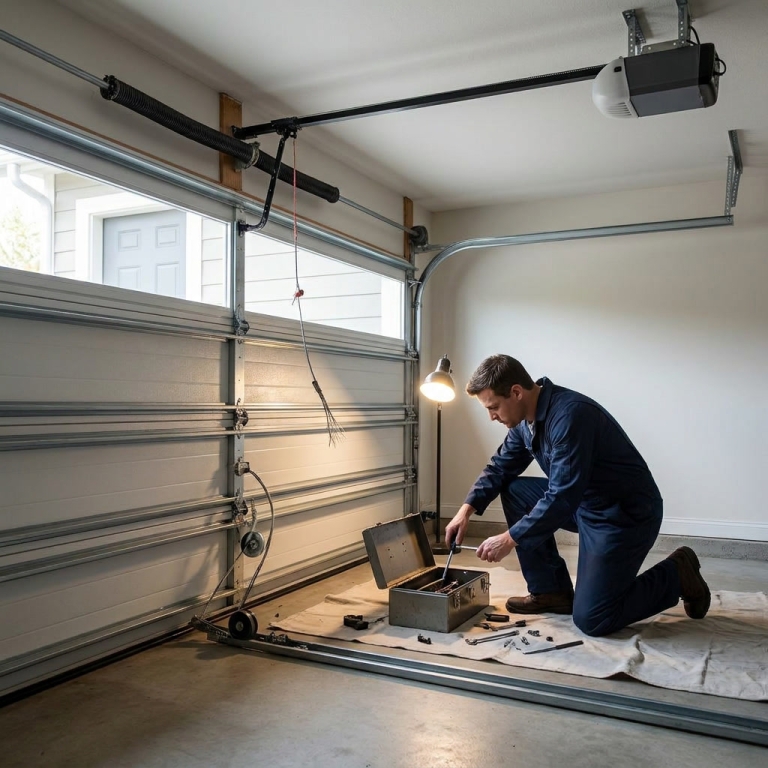
Tools and Supplies for Garage Door Lubrication
What you’ll need
Gather the following supplies before beginning:
- Silicone spray or a garage-door-rated lithium lubricant
- Clean shop towels or microfiber cloths
- A small nylon brush or old toothbrush
- Safety glasses
- Work gloves
- A sturdy step ladder, if needed
- A vacuum with a narrow attachment for loose dust
- A flashlight
Avoid using loose rags near a moving opener, and never place your fingers between hinge plates or roller brackets. A few minutes of preparation can prevent a painful pinch injury.
For more information about common door components, see our pages on garage door rollers and garage door hinges.
Choosing the right garage door lubricant
A quality silicone spray is a popular choice because it remains slippery without becoming excessively tacky. White lithium grease can also work well on metal pivot points and bearing surfaces. Many manufacturers sell products specifically labeled for garage doors, which is often the safest option.
Avoid general-purpose penetrating oils as your primary lubricant. Products designed mainly to loosen rust may evaporate quickly or leave insufficient long-term protection. Cooking oil is an especially poor choice because it can become sticky, turn rancid, and attract dust.
The product label matters. If your door manufacturer specifies a particular lubricant, follow those instructions. When in doubt, choose a light garage-door lubricant rather than a thick automotive grease.
Lubricant versus cleaner
Lubricant and cleaner perform different jobs. A cleaner removes grime, while lubricant leaves behind a low-friction film. Spraying lubricant over a heavily contaminated hinge can create a paste made from oil and grit.
Start by brushing or wiping away visible dust. If the hardware is greasy, use a suitable metal-safe cleaner on a cloth—not a flood of liquid sprayed into the door assembly. Let the area dry before applying lubricant.
Garage Door Safety Before You Begin
Disconnect the automatic opener
Safety comes first. Close the garage door fully, then unplug the opener or switch off its dedicated power supply. Most openers also have a manual emergency-release cord, but pulling it alone doesn’t necessarily remove electrical power.
Disconnecting the opener prevents the door from moving unexpectedly while your hands are near hinges, rollers, or brackets. Keep children and pets outside the work area, and make sure your ladder is positioned on a stable, level surface.
If the door is stuck open, partially open, or visibly crooked, don’t force it closed just to begin lubrication. A door held in an unusual position may have a broken spring, detached cable, or failed roller.
Do not adjust springs or cables
Garage door springs and lift cables store substantial energy. Torsion springs sit above the door, while extension springs may run along the horizontal tracks. Neither should be adjusted casually.
Never loosen spring cones, remove cable drums, stretch extension springs, or reposition lift cables as part of a lubrication project. These tasks require specialized tools and training.
If you see a loose cable, a gap in a torsion spring, or a spring that has separated, stop work. Contact a qualified garage door technician instead of attempting a quick fix.
Understand the door’s weight
A garage door can weigh hundreds of pounds, even when it feels light during powered operation. The opener does not make the door safe to handle; it simply moves the door through a mechanical system.
If you manually lift the door and it feels unusually heavy, drops quickly, or refuses to stay halfway open, the counterbalance system may be malfunctioning. Lubricant won’t correct that condition.
Inspecting Hinges Before Lubricating
How garage door hinges work
Garage door hinges connect individual door sections. Each hinge has a pivoting barrel, usually located at the side or center of the panel, allowing the sections to bend as the door travels around the curved track.
Look for:
- Cracked or bent hinge leaves
- Missing or loose screws
- Excessive rust
- Elongated screw holes
- Hinge barrels that no longer align
A hinge that is visibly bent should generally be replaced rather than lubricated. Tightening a screw may help if it has simply loosened, but don’t substitute longer screws without understanding the panel construction.
Read more about broken garage door hinges before attempting hardware replacement.
Identifying hinge pivot points
The pivot point is the cylindrical barrel through which the hinge pin passes. That is where a small amount of lubricant belongs. Apply the product to the barrel or pin area, not across the entire face of the hinge.
Use the spray’s extension tube when available. A controlled stream reduces overspray on the door panels and floor. One or two brief applications are usually enough.
Move the door manually a few inches at a time only when it is safe to do so and the opener is disconnected. This helps distribute lubricant through the hinge’s moving area.
Inspecting hinge screws
Loose hinge screws can cause rattling and misalignment. With the door closed and secure, check whether screws sit firmly against the hinge. Don’t over-tighten them, because excessive force can strip the panel or deform the hinge.
If a screw spins without gripping, the mounting hole may be damaged. That’s a repair issue, not a lubrication issue. A technician may need to use a different fastener, reinforce the mounting point, or replace the hinge.
Cleaning the Garage Door Tracks
Why tracks should not be coated
One of the most important rules in learning how to lubricate garage door hinges and tracks is understanding that the tracks themselves are guide surfaces, not traditional friction points. The rollers should turn inside the track, but the track should not be heavily greased.
A greasy track attracts dust, sand, and metal particles. Over time, that buildup can form an abrasive sludge that interferes with roller movement. In some cases, thick grease can cause rollers to drag or jump.
Instead of spraying the inside of the track, clean it. Wipe both vertical and horizontal sections with a dry cloth, then use a mild cleaner on stubborn residue if appropriate. Make sure the track is dry before operating the door.
Cleaning vertical tracks
Vertical tracks run beside the door when it is closed. Inspect them for leaves, cobwebs, dirt, dents, and loose mounting brackets.
Wipe from top to bottom while keeping your fingers away from the roller path. A narrow vacuum attachment can remove debris without pushing it deeper into the track.
Do not hammer a dented track back into shape while the door is under tension. Even a small deformation can affect alignment, and forcing the metal may make the problem worse.
Cleaning horizontal tracks
Horizontal tracks extend toward the back of the garage. They should be securely supported and aligned with the vertical tracks.
Check for sagging, loose bolts, or visible bends. Wipe the interior channel and inspect the curve where the vertical and horizontal tracks meet. This area often collects dust because it experiences constant roller movement.
If the track appears twisted or separated from its support, stop. A track adjustment may affect the door’s balance and should be handled professionally.
How to Lubricate Garage Door Hinges
Applying lubricant to hinge barrels
With the door closed and the opener disconnected, place the spray nozzle close to each hinge barrel. Apply a short burst, then wipe away any run-off.
Work from the bottom hinge upward. Center hinges are often easy to reach, while side hinges may sit near roller brackets. Use care around the lower corners because those areas can contain cables and brackets under tension.
Don’t soak the hinge. More lubricant is not better; excess product simply migrates onto panels, seals, and the garage floor.
Working hinge sections by hand
After applying lubricant, gently move the door manually if it remains safe to operate. Raise it a few inches, pause, then lower it. Repeat this process several times.
Listen for changes. A squeak that disappears after a few cycles may have been caused by a dry pivot. A grinding sound, popping noise, or sudden resistance suggests something more significant.
If the door feels heavy or uneven, stop moving it. Don’t keep cycling a door that may be out of balance.
Lubricating hinge pins
Some hinges have accessible pins, while others are enclosed within barrels. Apply lubricant where the pin meets the barrel, using a narrow nozzle for precision.
Avoid bending or removing a hinge pin while the door is installed. The weight of the panel can shift when a hinge is disturbed, and the section may move unexpectedly.
For a detailed inspection, a professional can determine whether the hinge needs lubrication, tightening, alignment, or replacement.
Lubricating Garage Door Rollers
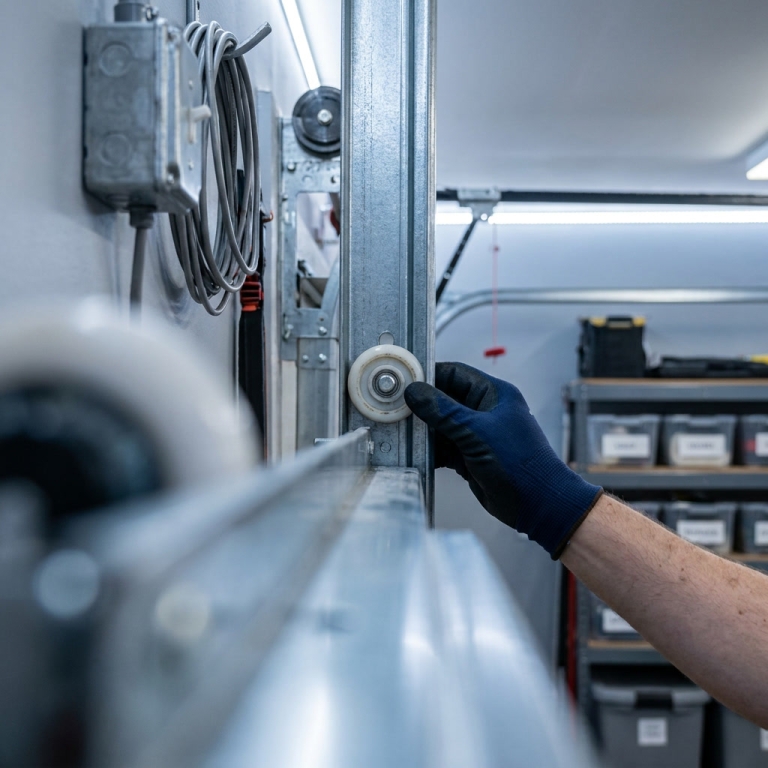
Roller stems and bearings
Garage door rollers may have exposed bearings, sealed bearings, or plastic bodies. The lubrication point is generally the bearing or the metal stem—not the track.
Apply a small amount to the roller bearing and allow it to work inward naturally. For sealed rollers, excessive spray offers little benefit. If a sealed roller is noisy, wobbly, or cracked, replacement may be more effective than lubrication.
Nylon rollers can be especially quiet, but their condition still matters. A worn nylon wheel may develop flat spots that create rhythmic thumping as the door moves.
Avoiding the bottom roller bracket
The bottom roller bracket is connected to the lift cable and is one of the most dangerous areas on the door. Do not remove it, loosen it, or manipulate the cable.
If lubrication is needed near the bottom roller, apply it only from a safe position without touching the cable or bracket hardware. If access is awkward, leave the work to a technician.
A small amount of noise is not worth risking serious injury.
Lubricating Garage Door Tracks Correctly
The proper approach to vertical tracks
The vertical track should be clean, straight, and firmly attached. In most cases, you don’t lubricate its interior. Instead, lubricate the roller bearings so the wheels travel smoothly through the track.
If a manufacturer explicitly recommends a light track lubricant, follow the product instructions and use an extremely thin application. Wipe away any visible excess.
Inspect the space between the track and the rollers. The roller should move freely without binding, scraping, or leaning sharply.
The proper approach to horizontal tracks
Horizontal tracks receive the rollers as the door travels overhead. They should also remain mostly clean and free of thick oil.
Check that the track slopes or aligns correctly according to the door design. Don’t alter the track angle simply because the door sounds noisy. Noise may originate from worn rollers, loose brackets, or the opener rather than the track itself.
If the rollers repeatedly jump out of the track, stop using the door. Repeated derailment is a serious hazard.
How Much Lubricant Should You Use?
The small-amount rule
A useful rule is to apply enough lubricant to create a thin film, not enough to form droplets. Begin with one short spray per pivot point. You can add a little more if the part remains dry, but removing excess is harder than adding it.
After lubrication, wipe all visible runs. Oil on the floor creates a slipping hazard, while oil on door panels can collect airborne dust.
A well-lubricated hinge should move quietly and smoothly. It should not drip, feel gummy, or leave an oily trail.
Why over-lubrication causes trouble
Too much lubricant can attract grit and make a garage door dirtier over time. It may also migrate onto weather seals, decorative panels, or the floor beneath the door.
Over-lubrication can mask noises temporarily without correcting the underlying defect. When the lubricant dries or becomes contaminated, the original problem may return—sometimes worse than before.
Use restraint. In garage door maintenance, a controlled application beats a generous one.
Common Lubrication Mistakes
Mistake: spraying the entire door
A broad spray may feel efficient, but it usually creates overspray and contamination. The door panels don’t need lubrication, and the weather seal should remain clean and flexible.
Aim only at approved moving points: hinge barrels, accessible roller bearings, and spring coils if the manufacturer permits spring lubrication.
Mistake: using household oil
Household oils may not withstand the dust, temperature changes, and pressure found in a garage door system. They can become sticky or evaporate rapidly.
Choose a product made for garage doors or a lubricant recommended by the manufacturer. The right formulation supports smoother operation without creating a dirt trap.
Mistake: ignoring alignment
A misaligned track, loose bracket, or bent hinge cannot be solved with spray lubricant. If the door rubs, binds, or hangs unevenly, investigate the mechanical cause.
See our garage door alignment service if the door doesn’t travel evenly after basic cleaning and lubrication.
How Often Should Garage Door Hinges and Tracks Be Lubricated?
A practical maintenance schedule
For many residential garage doors, lubrication once or twice per year is a reasonable starting point. Homes near the coast, busy households, dusty environments, and garages exposed to humidity may require more frequent inspection.
A good schedule is:
- Inspect every three months
- Clean tracks whenever debris is visible
- Lubricate moving pivot points every six to twelve months
- Inspect after storms, impact, or unusual noise
Always follow the door and opener manufacturer’s maintenance instructions. Some systems use specialized components that require particular products.
Seasonal maintenance
Before winter, inspect for stiff movement, rust, and hardened debris. Before summer, check for heat-related expansion, dry rollers, and loose hardware.
In humid regions such as South Florida, corrosion deserves special attention. Salt air and moisture can accelerate rust on hinges, rollers, brackets, and fasteners.
Routine care is simpler and less expensive than waiting for a door to fail during a storm or when you’re rushing to work.
Testing the Garage Door After Lubrication
Manual balance test
Keep the opener disconnected and lift the door manually to about waist height. A properly balanced door should remain close to that position rather than dropping rapidly or shooting upward.
Do not force the test if the door feels dangerously heavy. A failed balance test may indicate a spring or cable problem.
After lowering the door, reconnect the opener only when the system appears safe and the door is fully closed.
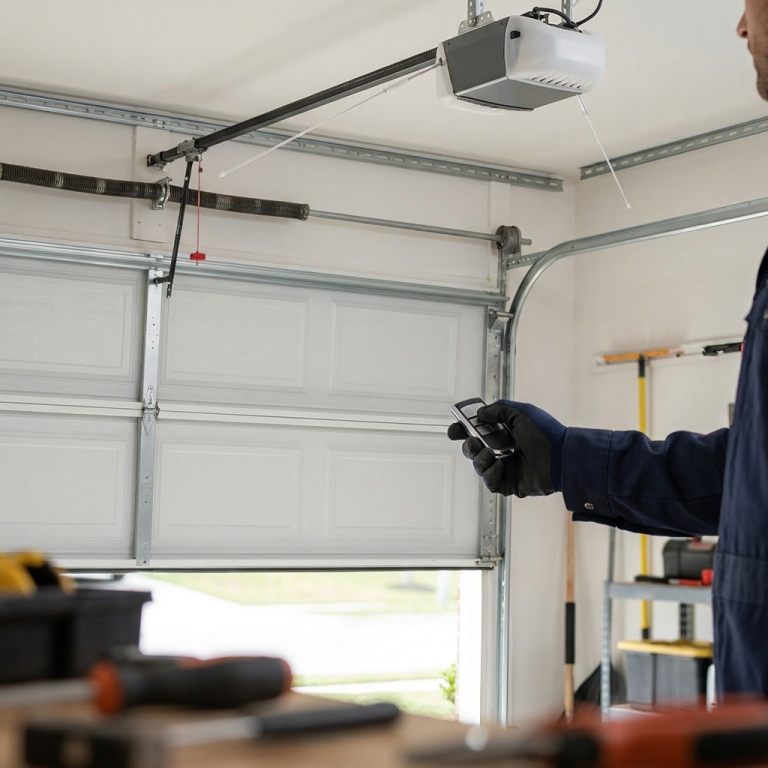
Automatic operation test
Stand clear of the door and use the wall control or remote. Watch the complete cycle.
Pay attention to:
- Jerking or hesitation
- Grinding or popping
- Uneven panel movement
- Rollers leaving the track
- Reversal problems
Test the opener’s safety-reversal system according to the manufacturer’s instructions. Never disable safety sensors or attempt to bypass them.
Diagnosing Garage Door Noise
Squeaking and squealing
A high-pitched squeak often points to a dry hinge, roller bearing, or spring. Lubrication may help if the component is otherwise healthy.
However, squealing can also come from a roller with a damaged bearing or a hinge that is under unusual stress. If the sound returns quickly, investigate further.
Grinding and scraping
Grinding usually deserves more attention than a simple squeak. It may indicate metal-on-metal contact, a bent track, damaged roller, or loose bracket.
Stop operating the door if scraping becomes severe. Continued use can damage multiple components and increase repair costs.
Banging and popping
A loud bang may indicate a broken torsion spring, while popping can result from a shifting panel, cable issue, or track problem. Don’t assume every loud sound is caused by dry hardware.
If a bang occurs and the door suddenly becomes heavy, don’t attempt lubrication. Contact a professional.
Lubrication in Humid and Coastal Climates
Managing rust and corrosion
Humidity encourages corrosion, especially around fasteners and unpainted metal. Wipe moisture from exposed hardware and inspect for bubbling paint, orange rust, or deep pitting.
A corrosion-resistant lubricant may help protect clean metal, but it cannot restore metal that has lost structural strength.
Coastal homes may need more frequent inspections because airborne salt can accelerate deterioration. Keep the garage ventilated when possible, and address leaks or standing water.
Weather seals and lubricant
Weather seals should generally be cleaned rather than saturated with petroleum-based products. Some products can soften, swell, or degrade rubber.
If a seal sticks to the floor or panels, use a manufacturer-approved treatment. Replace brittle, cracked, or torn seals instead of trying to revive them with excessive oil.
When Lubrication Is Not Enough
Signs of a broken spring
Common signs include:
- The door feels extremely heavy
- The opener hums but cannot lift the door
- A visible gap appears in a torsion spring
- Cables are loose or hanging
- The door rises only a few inches
A broken spring is not a DIY lubrication task. Springs must be replaced with the correct size and tension, and the system must be tested for balance.
Learn about garage door spring repair before deciding how to proceed.
Signs of track or roller failure
A door that jumps, binds, leans, or repeatedly leaves the track may have a damaged roller or misaligned track. Continuing operation can bend panels and place extra stress on the opener.
Keep everyone away from the door until it has been inspected. The safest next step is a professional diagnosis.
When to Call a Garage Door Professional
Emergency repair situations
Seek immediate help if the door is:
- Partially collapsed
- Hanging from one cable
- Off its tracks
- Unable to close securely
- Making sudden explosive noises
- Crushing or failing to reverse
Need emergency garage door repair near me in Broward County, Florida? Same-day service, 13+ years experience, 450+ five-star reviews. Call (954) 830-9661.
You can also request same-day garage door service when the door prevents you from securing your home or accessing your vehicle.
Professional inspection advantages
A trained technician can evaluate balance, spring tension, cable routing, track alignment, roller wear, hinge condition, and opener force settings as one connected system.
That matters because garage doors rarely fail in isolation. A worn roller can strain a hinge. A loose track can overload an opener. A damaged spring can make every other component work harder.
Professional service isn’t overkill when the door is heavy, unstable, or visibly damaged. It’s a sensible safety decision.
Frequently Asked Questions About Garage Door Lubrication
Can I use WD-40 on garage door hinges?
WD-40 and similar penetrating products may help displace moisture or loosen a stuck fastener, but they are not always ideal as the primary long-term garage door lubricant. For routine maintenance, use a silicone-based or garage-door-rated lithium lubricant.
Apply it to hinge barrels and roller bearings rather than coating the entire door or track. If noise returns quickly, inspect the component for wear instead of repeatedly spraying it.
Should I grease the inside of the garage door tracks?
Usually, no. The track should be clean and properly aligned, while the roller bearings should be lubricated. Greasing the track can attract dirt and create an abrasive paste.
If your manufacturer specifically recommends track lubrication, use only the approved product and apply a very thin film. Wipe away excess immediately.
How do I lubricate garage door rollers?
Disconnect the opener, close the door, and apply a small amount of lubricant to the roller bearing or metal stem. Keep lubricant away from the track interior and avoid touching the bottom roller bracket or lift cable.
If a roller is cracked, wobbly, flat-spotted, or noisy after lubrication, it likely needs replacement.
Why is my garage door still noisy after lubrication?
The noise may come from a worn bearing, loose hinge, damaged track, unbalanced spring system, opener gear, chain, belt, or mounting bracket. Lubrication only helps when friction is the actual cause.
Listen carefully to locate the sound, but don’t place your hands near moving components. Persistent or worsening noise warrants an inspection.
Can I lubricate a garage door while it is open?
It’s safer to begin with the door closed because a closed door is generally more stable and reduces the risk of movement. Disconnect the opener before working near hinges and rollers.
If the door is stuck open or only partly open, don’t force it. The position may be caused by a spring, cable, or track failure.
How often should I lubricate garage door hinges and tracks?
Many residential doors benefit from lubrication every six to twelve months, with more frequent checks in humid, dusty, or coastal areas. Clean tracks whenever debris appears.
The best schedule depends on usage, climate, hardware type, and manufacturer guidance. A quarterly visual inspection can identify problems before they become emergencies.
Is silicone spray better than lithium grease?
Neither is universally better. Silicone spray is convenient, clean, and suitable for many pivot points. White lithium grease can provide longer-lasting coverage on certain metal surfaces.
Choose a product labeled for garage doors and follow the manufacturer’s recommendations. Avoid thick applications that attract dirt.
A Simple Garage Door Lubrication Checklist
Before starting
- Close the door fully
- Disconnect electrical power to the opener
- Put on gloves and safety glasses
- Inspect springs, cables, tracks, hinges, and rollers
- Confirm there are no obvious structural failures
During the job
- Clean visible dirt first
- Apply small amounts to hinge barrels
- Lubricate accessible roller bearings
- Keep grease out of the tracks
- Stay away from bottom brackets and cables
- Wipe away excess product
After the job
- Cycle the door manually if safe
- Reconnect the opener
- Test automatic operation
- Listen for unusual sounds
- Test safety features according to the manual
- Schedule professional service for persistent problems
Final Summary: How to Lubricate Garage Door Hinges and Tracks Safely
Learning how to lubricate garage door hinges and tracks is mostly a matter of precision and restraint. Clean the tracks rather than flooding them with grease, lubricate hinge barrels and roller bearings sparingly, and keep all products away from cables, safety sensors, belts, and decorative panels.
Always disconnect the opener before working near moving hardware. Never adjust springs or cables unless you’re a trained professional with the right equipment. After lubrication, operate the door cautiously and pay attention to balance, alignment, sound, and smooth travel.
A small amount of routine maintenance can extend the life of hinges, rollers, and other components. But when the door is heavy, crooked, off-track, or suddenly loud, don’t gamble on another spray of lubricant. Professional diagnosis is the safer and smarter solution.
Skip the YouTube rabbit hole - we'll have a tech at your door same day across Broward, Dade and Palm Beach.